
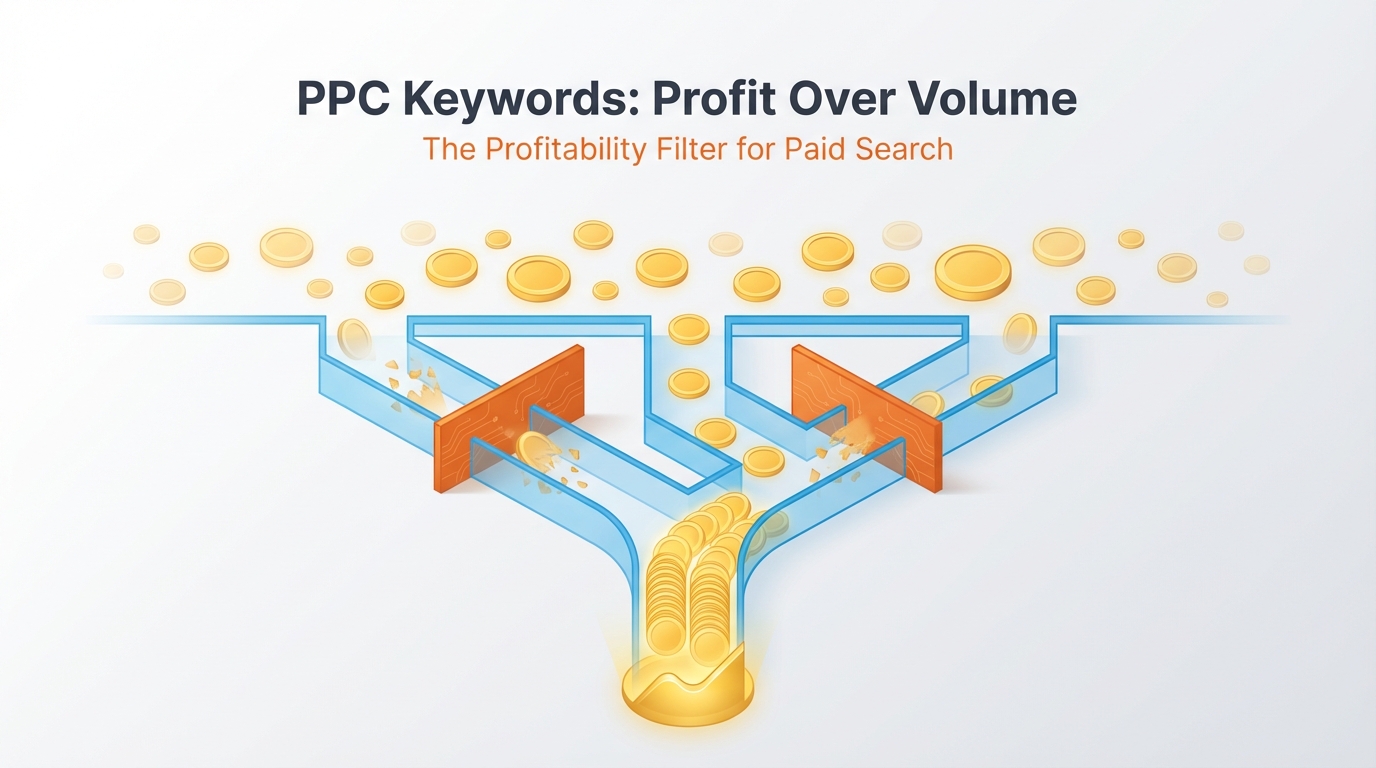
Keyword Research for PPC Campaigns: The Profitability Filter Most Advertisers Ignore
You're spending £6,500 monthly on Google Ads. Your campaigns
target 412 keywords. Your click-through rate sits at 4.7% above industry
average. Your Quality Scores average 8/10.
Yet your cost per acquisition keeps climbing. Your return on
ad spends hovers at 1.8x barely profitable. Your sales team complains that PPC
leads lack buying intent.
This isn't a bidding problem. It's a keyword strategy
failure.
Most businesses approach PPC keyword research the same way
they approach SEO: chasing search volume and low competition. But PPC isn't
about accumulating traffic it's about purchasing attention from buyers ready to
convert. The wrong keywords don't just waste budget—they actively destroy
profitability by attracting unqualified visitors who never convert.
Strategic PPC keyword research operates on one principle: every
keyword must justify its cost through measurable profit. This guide reveals
how to transform your keyword research from a volume game into a profitability
engine.
The Critical Difference: PPC Keywords vs. SEO Keywords
SEO keyword research seeks sustainable organic visibility
over months. PPC keyword research seeks immediate commercial returns today.
This fundamental difference changes everything:
|
Factor |
SEO
Keyword Research |
PPC
Keyword Research |
|
Primary goal |
Topical authority & long-term visibility |
Immediate conversions & profit |
|
Intent focus |
All funnel stages (top-heavy) |
Bottom-funnel commercial intent |
|
Volume priority |
Important (traffic accumulation) |
Secondary (profit per click matters more) |
|
Competition view |
Avoid highly competitive terms |
Target high commercial intent—even if competitive |
|
Success metric |
Rankings & organic traffic |
Profit per keyword & ROAS |
The biggest mistake advertisers make? Using SEO keyword
lists for PPC campaigns. Those informational "how-to" keywords that
drive organic blog traffic will bankrupt your PPC budget—they attract
researchers, not buyers.
The Profitability Filter: Three Questions Every Keyword
Must Pass
Before adding a single keyword to your PPC campaigns, run it
through this profitability filter:
Question 1: Does This Keyword Signal Commercial Intent?
Commercial intent keywords contain buying signals:
- Transactional
terms: "buy," "price," "cost,"
"quote," "demo"
- Vendor-specific
terms: "[competitor] alternative," "vs [competitor]"
- Solution-specific
terms: "CRM software pricing," "SEO agency London"
Avoid informational keywords unless part of a deliberate
top-funnel strategy with separate budget and conversion goals.
Red flag keywords to avoid in bottom-funnel campaigns:
- "Free,"
"cheap," "DIY," "how to,"
"tutorial," "tips," "vs free alternatives"
Question 2: Can We Actually Convert This Searcher?
Some keywords attract audiences you cannot serve profitably:
- "Free
CRM software" → attracts users unwilling to pay
- "SEO
jobs" → attracts job seekers, not clients
- "Marketing
salary" → attracts researchers, not buyers
Before bidding, ask: "Does our offering actually solve
what this searcher wants?" If not, no amount of optimisation will make
that keyword profitable.
Question 3: Does the Expected Value Exceed the Expected
Cost?
Calculate minimum viable keyword value:
1
Example for B2B services:
- Average
conversion rate: 3.5%
- Average
deal value: £4,200
- Target
ROAS: 4.0x
Minimum Viable CPC = (3.5% × £4,200 × 4.0) ÷ 100 = £5.88
Any keyword with expected CPC above £5.88 requires either
higher conversion rates, larger deal values, or lower acquisition costs to be
profitable. Bid accordingly—or exclude entirely.
The Negative Keyword Imperative
While positive keywords get attention, negative keywords
protect profit. Every day without negative keyword optimisation, you're
literally paying to attract the wrong audience.
Critical negative keyword categories:
|
Category |
Examples |
Why
Exclude |
|
Free seekers |
free, cheap, discount, trial only |
Won't convert to paid customers |
|
Job seekers |
careers, jobs, hiring, salary |
Looking for employment, not services |
|
Students/researchers |
school project, homework, student |
No buying authority or budget |
|
Competitor employees |
work at [competitor], careers [competitor] |
Already employed by competitors |
|
Informational only |
how to, tutorial, guide, vs free |
Seeking education, not vendors |
Action step: Review your search term report weekly.
Add irrelevant terms as negative keywords immediately. One client reduced
wasted spend by 37% in 30 days simply by adding negative keywords they'd
ignored for six months.
Strategic Match Type Deployment
Match types aren't technical settings they're strategic
filters determining who sees your ads.
Exact match [keyword]:
- Use
for: High-converting, bottom-funnel keywords with proven ROI
- Strategy:
Start campaigns with exact match to establish baseline performance
- Budget
allocation: 60-70% of budget once performance is proven
Phrase match "keyword":
- Use
for: Expanding reach while maintaining intent control
- Strategy:
Layer on top of exact match winners to capture related queries
- Budget
allocation: 20-30% of budget
Broad match modified +keyword:
- Use
for: Discovery of new high-intent queries (use cautiously)
- Strategy:
Small test budget (5-10%) with aggressive negative keyword management
- Warning:
Can quickly drain budget on irrelevant searches without strict controls
Never use pure broad match in performance
campaigns—it surrenders intent control to Google's algorithm.
The Keyword Grouping Profit Multiplier
Poorly structured campaigns destroy Quality Scores and
inflate costs. Strategic keyword grouping increases ad relevance, improves
Quality Scores, and reduces CPCs by 25-40%.
The rule: Group keywords by searcher intent,
not just topic similarity.
❌ Poor grouping (mixed intent):
- "CRM
software"
- "free
CRM tools"
- "CRM
implementation services"
- "how
to choose CRM"
✅ Strategic grouping (aligned
intent):
- Group
1 (Transactional): "buy CRM software," "CRM
pricing," "CRM demo"
- Group
2 (Commercial Investigation): "best CRM for small business,"
"HubSpot vs Salesforce"
- Group
3 (Service-Based): "CRM implementation services," "CRM
consultant London"
Each group gets its own ad copy speaking directly to that
specific intent. Result: higher CTRs, better Quality Scores, lower CPCs, and
higher conversion rates.
Ongoing Optimisation: The Search Term Report Ritual
Keyword research doesn't end at campaign launch it's a
continuous profit protection activity.
Weekly search term report process:
- Download
search terms report for past 7 days
- Identify
converting queries—add as exact match keywords
- Identify
irrelevant queries—add as negative keywords immediately
- Identify
high-impression/low-CTR queries—pause or add as negatives
- Calculate
actual CPC and conversion rate by query—not just keyword
One e-commerce client discovered 43% of their ad spend went
to queries containing "cheap" and "discount"—audiences with
0.3% conversion rates. After adding these as negatives, ROAS increased from
2.1x to 4.7x without increasing budget.
The Bottom Line: Keywords Are Profit Levers, Not Traffic
Sources
PPC keyword research isn't about finding popular searches.
It's about identifying commercial intent signals worth paying for and
ruthlessly excluding everything else.
The most profitable PPC accounts aren't the ones bidding on
the most keywords. They're the ones bidding on the right keywords with
surgical precision, while aggressively filtering out waste through negative
keywords and intent-based grouping.
Stop chasing search volume. Start engineering for profit per
keyword. Your bottom line will thank you.
Ready to Transform Your PPC Keyword Strategy?
If your current PPC campaigns generate clicks but not
profit, your keyword strategy is likely leaking budget daily.
Media Junkie conducts PPC Profitability Audits that
identify exactly which keywords drive revenue—and which ones silently destroy
your margins.
Book Your Free PPC Keyword Audit
We'll analyse your search term reports and deliver a prioritized action plan
showing precisely which keywords to bid on, which to exclude, and how to
restructure for maximum profitability.