
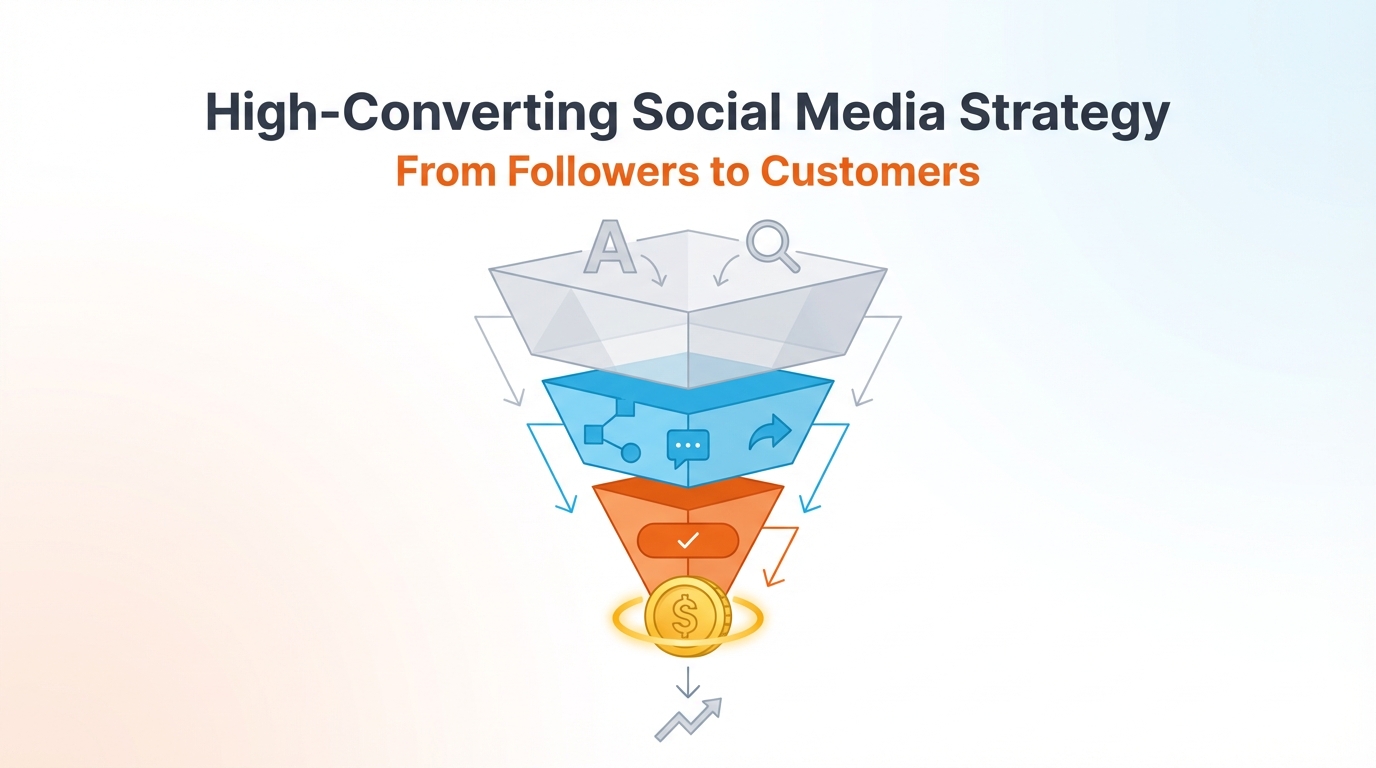
How to Build a High-Converting Social Media Strategy
You're posting consistently. Your engagement metrics look
healthy. Your follower count is growing steadily. Yet your sales pipeline
remains stagnant, and your social media efforts aren't translating into
measurable revenue.
This disconnect between activity and results is the most
common frustration businesses face with social media marketing. The problem
isn't your content quality or posting frequency it's your strategy.
A high-converting social media strategy isn't about going
viral or accumulating likes. It's about systematically guiding your ideal
customers through their buying journey and removing friction at every touch point. This guide will walk you through building a social media strategy
that actually drives conversions and revenue.
Shift Your Mindset: From Broadcasting to Converting
Before diving into tactics, you must fundamentally shift how
you view social media. Most businesses treat social platforms as megaphones for
broadcasting their message to the masses. This approach generates noise but
rarely drives meaningful business outcomes.
Instead, view social media as a conversion ecosystem a
carefully designed environment where each piece of content serves a specific
purpose in moving prospects closer to purchase.
This mindset shifts changes everything:
- Content
is created with conversion goals in mind, not just engagement potential
- Platform
selection is based on where your buyers actually research solutions
- Success
is measured by revenue generated, not vanity metrics
- Every
post has a clear next step for your audience
When you approach social media as a conversion channel
rather than a broadcast platform, your entire strategy transforms from
activity-based to results-driven.
Step 1: Define Your Conversion Goals Before Creating
Content
Most businesses create content first and worry about
conversions later. This backwards approach guarantees mediocre results.
Start by clearly defining what "conversion" means
for your business on social media. Common conversion goals include:
- Lead
generation: Email sign-ups, contact form submissions, demo requests
- Direct
sales: Product purchases, service bookings, subscription sign-ups
- Appointment
setting: Consultation bookings, sales calls, discovery meetings
- Content
downloads: Whitepapers, case studies, resource guides
- Community
building: Private group memberships, event registrations
Once you've defined your primary conversion goal, every
piece of content you create should support that objective. If a post doesn't
move prospects closer to conversion, it shouldn't be part of your strategy.
Step 2: Map Content to the Buyer's Journey
High-converting social strategies align content with where
prospects are in their buying journey. The three-stage framework is simple but
powerful:
Top of Funnel (Awareness Stage)
At this stage, prospects are experiencing a problem but
haven't yet identified solutions. Your content should:
- Educate
without selling
- Address
pain points and challenges
- Establish
your expertise and credibility
- Build
trust through value-first content
Content examples: Problem-awareness posts, industry
insights, educational tips, behind-the-scenes content
Middle of Funnel (Consideration Stage)
Prospects now know they need a solution and are evaluating
options. Your content should:
- Showcase
your unique approach and methodology
- Provide
social proof through case studies and testimonials
- Address
common objections and concerns
- Demonstrate
expertise through detailed insights
Content examples: Case studies, client testimonials,
comparison content, detailed how-to guides
Bottom of Funnel (Decision Stage)
Prospects are ready to buy and comparing final options. Your
content should:
- Make
the decision easy and low-risk
- Highlight
specific benefits and outcomes
- Include
clear calls-to-action
- Remove
friction from the buying process
Content examples: Limited-time offers, pricing
transparency, demo videos, consultation CTA
The key is to ensure you have content for each stage and
that prospects can easily move from awareness to decision through your social
ecosystem.
Step 3: Choose Platforms Based on Buyer Behavior, Not
Popularity
Many businesses spread themselves thin across multiple
platforms, diluting their impact and wasting resources. A high-converting
strategy focuses on the platforms where your buyers actually spend time
researching solutions.
Ask yourself:
- Where
do your ideal customers go when they have problems like yours?
- Which
platforms do they use for professional research versus personal discovery?
- What
type of content do they consume at each stage of their journey?
B2B businesses typically find the most conversion
success on:
- LinkedIn:
Professional research and vendor evaluation
- Twitter/X:
Industry conversations and real-time insights
- YouTube:
Educational content and product demonstrations
B2C businesses typically find the most conversion
success on:
- Instagram:
Visual proof and lifestyle association
- Facebook:
Community building and targeted advertising
- TikTok:
Authentic storytelling and trend participation
- Pinterest:
Inspiration and discovery for visual products
Focus 80% of your efforts on one or two platforms where your
buyers are most active, rather than spreading thin across five platforms with
mediocre results.
Step 4: Optimize for Platform-Specific Conversion
Mechanics
Each social platform has unique conversion mechanics.
High-converting strategies leverage these native features rather than directing
users off-platform.
LinkedIn Conversion Tactics
- Use
LinkedIn Lead Gen Forms for frictionless lead capture
- Include
clear CTAs in posts with direct links to landing pages
- Leverage
LinkedIn Articles for long-form content with embedded CTAs
- Use
LinkedIn Live for real-time engagement and immediate action
Instagram Conversion Tactics
- Utilize
Instagram Shopping tags for direct product purchases
- Implement
Instagram Action Buttons (Contact, Book, Learn More)
- Use
Instagram Stories with swipe-up links for time-sensitive offers
- Leverage
Instagram Guides for product recommendations and resources
Facebook Conversion Tactics
- Create
Facebook Lead Ads with pre-filled forms
- Build
private Facebook Groups for community-driven conversions
- Use
Facebook Shops for seamless e-commerce integration
- Implement
Facebook Messenger bots for automated lead qualification
TikTok Conversion Tactics
- Use
TikTok Spark Ads to leverage authentic UGC-style content
- Implement
TikTok Shopping features for direct purchases
- Create
shoppable videos with product links
- Use
TikTok Lead Generation ads for contact capture
The key is to make conversion as frictionless as possible by
using native platform features rather than always directing users to external
websites.
Step 5: Implement Strategic CTAs That Drive Action
Every social media post should have a clear next step for
your audience. Without a call-to-action, even highly engaged followers won't
know what to do next.
Effective CTAs are:
- Specific:
Tell users exactly what action to take
- Valuable:
Explain the benefit of taking that action
- Urgent:
Create a reason to act now rather than later
- Low-friction:
Make the action easy and accessible
Examples of high-converting CTAs:
- "Comment
'GUIDE' below and I'll DM you our free resource"
- "Tap
the link in bio to book your free consultation"
- "Save
this post for when you're ready to take the next step"
- "DM
me 'STRATEGY' to get our custom plan for your business"
Avoid generic CTAs like "Learn more" or
"Click here." Instead, be specific about what users will get and why
they should act now.
Step 6: Track and Optimize Based on Conversion Data
You can't improve what you don't measure. High-converting
social strategies are built on data, not assumptions.
Track these key metrics:
- Conversion
rate: Percentage of engaged users who take desired action
- Cost
per conversion: How much you spend to acquire each lead/customer
- Conversion
value: Revenue generated from social media efforts
- Funnel
progression: How users move from awareness to decision
Use UTM parameters to track social traffic through your
website and into your CRM. This allows you to see exactly which platforms,
posts, and campaigns drive the most valuable conversions.
Regularly review your conversion data and double down on
what works. If certain content types, posting times, or platforms consistently
drive conversions, allocate more resources there. If something isn't
converting, either optimize it or eliminate it.
Step 7: Build Trust Through Social Proof
People buy from businesses they know, like, and trust.
Social media is uniquely positioned to build this trust through authentic
social proof.
Incorporate these trust-building elements:
- Client
testimonials: Video testimonials perform 3x better than text
- Case
studies: Show specific results and outcomes you've delivered
- User-generated
content: Share content created by happy customers
- Behind-the-scenes:
Humanize your brand through authentic glimpses
- Expert
positioning: Share insights that demonstrate your expertise
Trust is the currency of conversion. The more trust you
build through authentic social proof, the easier it becomes to convert
followers into customers.
Common Mistakes That Kill Social Media Conversions
Even with a solid strategy, these common mistakes can
sabotage your conversion efforts:
Mistake #1: Inconsistent posting Irregular posting
confuses your algorithm and frustrates your audience. Create a consistent
posting schedule and stick to it.
Mistake #2: Ignoring engagement social media is a
two-way conversation. Respond to comments, answer questions, and engage with
your audience's content.
Mistake #3: Over-promoting the 80/20 rule still
applies: 80% value, 20% promotion. Too much selling drives people away.
Mistake #4: Poor visual quality Low-quality images
and videos signal low-quality offerings. Invest in good visual content.
Mistake #5: No clear brand voice Inconsistent
messaging confuses your audience. Develop a clear brand voice and maintain it
across all content.
The Bottom Line: Strategy Over Activity
A high-converting social media strategy isn't about posting
more frequently or creating flashier content. It's about aligning every piece
of content with your business goals and guiding prospects through a clear path
to conversion.
Focus on quality over quantity. Build trust before asking
for the sale. Track what actually drives revenue, not just engagement. And
remember: social media success is measured in customers acquired, not likes
accumulated.
When you approach social media as a conversion channel
rather than a broadcast platform, you'll finally see the ROI that's been
eluding you.
Ready to Transform Your Social Media into a Conversion
Machine?
If your current social media efforts aren't driving
measurable results, it's time for a strategic overhaul.
Media Junkie specializes in building high-converting social
media strategies that generate qualified leads and drive revenue—not just
engagement metrics.
Book Your Free Social Media Strategy Session
We'll analyse your current approach and deliver a customized road map to
transform your social channels into predictable revenue generators.