
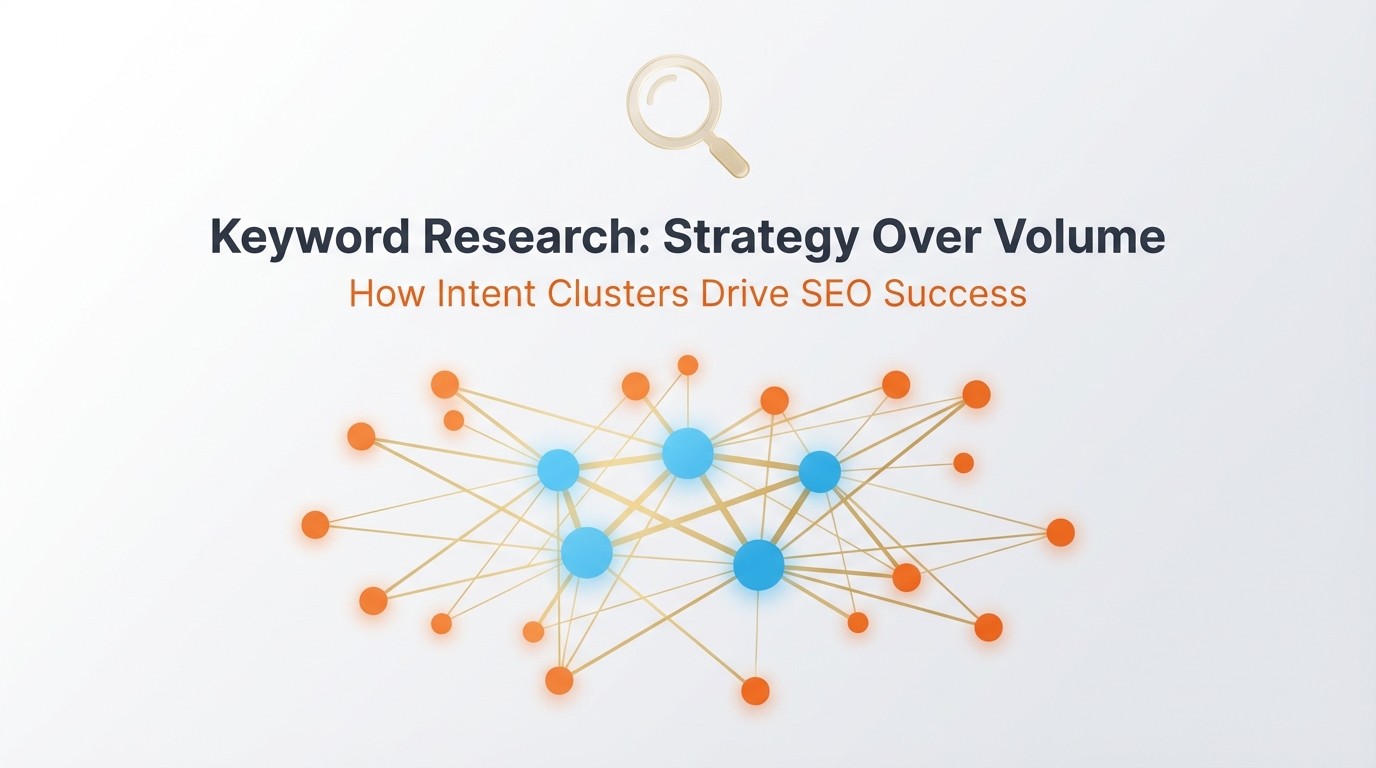
How Keyword Research Drives SEO Success (Beyond Volume and Competition)
You've published 87 blog posts. Your content team works
tirelessly. Your SEO agency reports "ranking improvements" for
hundreds of keywords.
Yet organic traffic remains stagnant. Qualified leads from
search are minimal. Your most popular content drives engagement but zero
conversions.
The problem isn't your content quality or publishing
frequency. It's your keyword strategy.
Most businesses treat keyword research as a tactical
exercise finding popular terms with low competition and creating content to
target them. This approach generates traffic but rarely drives meaningful
business outcomes.
Strategic keyword research is fundamentally different. It's
not about what people search it's about why they search and what they
do after they find you. When done correctly, keyword research becomes the
foundation of your entire content strategy, aligning every piece of content
with actual business objectives.
Here's how to transform keyword research from a tactical
checkbox into your most powerful SEO asset.
The Strategic Shift: From Keywords to Intent Clusters
Traditional keyword research focuses on individual search
terms. Strategic keyword research focuses on intent clusters groups of
related queries that represent a complete buyer journey.
Consider someone researching project management software:
- Awareness
stage: "how to manage remote teams," "project
management challenges"
- Consideration
stage: "best project management tools," "Asana vs
Trello comparison"
- Decision
stage: "project management software pricing," "Asana
free trial"
These aren't separate keywords they're a single intent
cluster representing one buyer's complete journey. Strategic keyword research
identifies these clusters and creates comprehensive content that satisfies the
entire journey, not just individual queries.
This approach has three critical advantages:
- Deeper
topical authority: Google rewards content that comprehensively covers
a topic, not just scratches the surface
- Higher
conversion potential: Content addressing the full journey captures
users at every stage, not just one touchpoint
- Sustainable
rankings: Intent clusters are harder for competitors to replicate than
individual keywords
The Four Types of Search Intent (And How to Target Each)
Every search query falls into one of four intent categories.
Understanding which type you're targeting determines your content strategy and
conversion approach.
1. Informational Intent
Users seeking answers, education, or solutions to problems.
Examples: "how to improve website speed,"
"what is content marketing," "project management best
practices"
Content strategy: Educational blog posts, guides,
tutorials, how-to articles
Conversion approach: Capture emails through content
upgrades, lead magnets, or newsletter subscriptions
Mistake to avoid: Trying to sell directly in
informational content build trust first, sell later
2. Navigational Intent
Users looking for a specific website or brand.
Examples: "Media Junkie," "HubSpot
login," "Apple support"
Content strategy: Optimise brand pages, ensure proper
technical SEO, dominate branded search
Conversion approach: Direct users to the specific
page they're seeking reduce friction
Mistake to avoid: Creating competing pages that
cannibalize branded traffic
3. Commercial Investigation Intent
Users researching products or services before purchasing.
Examples: "best CRM software 2026,"
"HubSpot vs Salesforce," "project management tool reviews"
Content strategy: Comparison content, case studies,
product reviews, buyer's guides
Conversion approach: Position your solution as the
best choice, address objections, provide social proof
Mistake to avoid: Being too promotional provide
genuine value and let your solution speak for itself
4. Transactional Intent
Users ready to purchase or take action.
Examples: "buy project management
software," "HubSpot pricing," "free CRM trial"
Content strategy: Product pages, pricing pages, demo
request forms, consultation booking
Conversion approach: Remove friction, make the next
step obvious, create urgency
Mistake to avoid: Sending transactional-intent users
to blog posts get them to the conversion point immediately
The key insight: Your content mix should mirror your
buyer journey. If 70% of your content targets informational intent but only
10% targets commercial or transactional intent, you're educating your audience
but not converting them.
The Keyword Research Process That Actually Works
Forget keyword tools that just show search volume and
competition. Strategic keyword research follows this five-step process:
Step 1: Start with Your Business Goals
Before researching a single keyword, define what success
looks like:
- Are
you trying to generate leads for high-ticket services?
- Are
you selling e-commerce products directly?
- Are
you building brand awareness in a new market?
- Are
you establishing thought leadership in your industry?
Your business goals determine which keywords are actually
valuable. A keyword with 10,000 monthly searches might be worthless if it
doesn't align with your objectives.
Step 2: Interview Your Customers and Sales Team
Your best keyword insights come from real conversations, not
tools:
- Ask
recent customers: "What did you Google before finding us?"
- Ask
your sales team: "What questions do prospects ask during discovery
calls?"
- Review
support tickets: "What problems are customers trying to solve?"
This qualitative research reveals the actual language your
buyers use often different from what you assume.
Step 3: Map Keywords to the Buyer Journey
Don't just collect keywords organize them by intent and
funnel stage:
|
Funnel
Stage |
Intent
Type |
Keyword
Examples |
Content
Type |
|
Awareness |
Informational |
"how to improve SEO," "content marketing
challenges" |
Blog posts, guides, educational content |
|
Consideration |
Commercial Investigation |
"best SEO tools," "SEO agency vs
in-house" |
Comparison content, case studies, buyer's guides |
|
Decision |
Transactional |
"hire SEO agency," "SEO pricing" |
Service pages, pricing, consultation CTAs |
This mapping ensures your content strategy covers the entire
journey, not just random topics.
Step 4: Evaluate Keyword Value, Not Just Volume
Search volume is a vanity metric. Keyword value is what
matters.
Ask these questions for each keyword:
- Commercial
intent: Does this query indicate someone ready to buy?
- Conversion
potential: How likely are visitors from this keyword to convert?
- Lifetime
value: What's the potential customer value from this search?
- Content
ROI: Can we create content that ranks AND converts for this keyword?
A keyword with 500 monthly searches and high commercial
intent often outperforms a keyword with 5,000 searches and zero buying intent.
Step 5: Analyze the Competition (Strategically)
Don't just check competition scores analyse what's actually
ranking:
- Are
the top results from authoritative sites (Forbes, HubSpot) or smaller
competitors?
- Is
the content comprehensive or thin?
- Are
there featured snippets or other SERP features dominating results?
- Can
you create something significantly better?
If the top results are from sites with 10x your domain
authority and comprehensive content, that keyword might not be worth pursuing no
matter how attractive the volume looks.
Common Keyword Research Mistakes That Sabotage SEO
Even experienced marketers fall into these traps:
Mistake #1: Chasing High-Volume, Low-Intent Keywords
"Marketing" gets 1.2 million searches monthly.
"B2B SaaS marketing agency London" gets 210. Guess which one actually
drives qualified leads?
High-volume keywords attract broad audiences, including
students, researchers, and competitors not buyers. Focus on specific,
commercial-intent keywords even if volume is lower.
Mistake #2: Ignoring Long-Tail Keywords
Long-tail keywords (3+ words) have lower volume but higher
conversion rates. They're also easier to rank for because competition is lower.
"SEO" is nearly impossible to rank for. "SEO
for B2B SaaS companies" is achievable and attracts qualified buyers.
Mistake #3: Targeting Keywords Without Conversion Paths
Some keywords simply don't convert. "Free SEO
tools" attracts people looking for free solutions, not paid services.
"SEO tips" attracts DIYers, not agencies.
Before targeting a keyword, ask: "Can we actually
convert someone searching this?"
Mistake #4: Not Updating Keyword Research Regularly
Search behaviour changes. New terms emerge. Old terms fade.
Your keyword strategy should evolve quarterly, not annually.
Set calendar reminders to revisit your keyword research and
adjust based on performance data and market changes.
How to Prioritize Keywords for Maximum Impact
You can't target every keyword. You need a system for
prioritization.
Use this simple scoring framework:
Keyword Value Score = (Search Volume × 0.3) + (Commercial
Intent × 0.4) + (Conversion Potential × 0.3)
Rate each factor 1-10, then calculate the weighted score.
Focus on keywords scoring 7+.
Example:
- "SEO
tips" → Volume: 8, Intent: 2, Conversion: 1 → Score: 3.5 (low
priority)
- "Hire
SEO agency London" → Volume: 4, Intent: 9, Conversion: 8 → Score: 6.8
(medium priority)
- "B2B
SaaS SEO agency pricing" → Volume: 3, Intent: 10, Conversion: 9 →
Score: 8.2 (high priority)
This system prevents you from chasing volume while ignoring
actual business value.
The Bottom Line: Keywords Are Strategy, Not Tactics
Keyword research isn't a one-time task you complete before
writing content. It's an ongoing strategic process that informs every aspect of
your SEO and content marketing.
When done correctly, keyword research:
- Aligns
content with actual buyer needs and intent
- Prioritizes
efforts based on business value, not just search volume
- Creates
comprehensive content that satisfies entire buyer journeys
- Drives
qualified traffic that actually converts
- Provides
a framework for measuring content ROI
Stop treating keyword research as a tactical checkbox. Start
treating it as the strategic foundation of your entire SEO program. The
difference between traffic and revenue often comes down to this one discipline.
Ready to Transform Your Keyword Strategy?
If your current keyword research isn't driving qualified
traffic and conversions, it's time for a strategic overhaul.
Media Junkie conducts comprehensive keyword research that
identifies not just what people search but what actually drives revenue for
your business.
Book Your Free Keyword Strategy Audit
We'll analyse your current keyword approach and deliver a prioritized roadmap
showing exactly which keywords will move your revenue needle.