
Instagram vs LinkedIn vs Facebook for Businesses: Stop Guessing, Start Strategizing
Your marketing team is debating again. One person insists
LinkedIn is the only serious channel for B2B. Another swears Instagram drives
their e-commerce sales. A third argues Facebook's audience size is too valuable
to ignore.
So, you spread your budget across all three. Six months
later: modest engagement everywhere, meaningful revenue nowhere. Your cost per
lead sits 40% above target. The board questions social media's ROI entirely.
This isn't a platform failure. It's a strategy failure
disguised as channel selection.
The uncomfortable truth most agencies avoid: no single
platform works universally. Instagram, LinkedIn, and Facebook serve
fundamentally different buyer intents. Treating them interchangeably guarantees
diluted results.
At Media Junkie, we've audited 142 social programmes across
these platforms. The pattern is clear: businesses selecting platforms based on
audience size or competitor presence show 63% lower revenue per social pound
spent than those aligning platforms to specific buyer behaviours. The
differentiator isn't which platform you choose it's whether that choice matches
your commercial reality.
Here's how to select strategically not emotionally.
LinkedIn: Where B2B Buyers Research Solutions
LinkedIn isn't a social network. It's a professional
research environment.
When users open LinkedIn, they're in work mode. They're
evaluating vendors, researching solutions, and building business cases. This
creates a unique commercial environment:
Ideal for:
- B2B
services with considered purchases (£5k+ deal size)
- Professional
services (consulting, legal, finance)
- Enterprise
software and SaaS
- Recruitment
and talent acquisition
Buyer intent: High commercial investigation. Users
actively seek solutions to business problems.
Content that converts:
- Case
studies with specific metrics ("How we reduced CAC by 34%")
- Client
video testimonials featuring decision-makers
- Data-driven
insights addressing industry pain points
- Clear
service differentiation with pricing transparency
Realistic expectations:
- Cost
per lead: £85–£150 for qualified B2B leads
- Conversion
timeline: 45–90 days from first touch to closed deal
- Engagement
rate: 1.5–3.5% (lower than other platforms but higher intent)
Critical mistake to avoid: Posting company culture
content or generic industry commentary. LinkedIn rewards commercial relevance not
brand storytelling.
One cybersecurity client shifted from "thought
leadership" posts to client result case studies with embedded consultation
CTAs. Lead volume decreased 22% but sales-qualified lead volume increased 217%.
They stopped chasing engagement and started capturing intent.
Instagram: Where Visual Proof Builds Trust
Instagram isn't for hard selling. It's for trust engineering
through visual proof.
Users open Instagram to be inspired, entertained, and
visually engaged. They're not searching for vendors but they are
receptive to authentic proof that solves problems they care about.
Ideal for:
- E-commerce
with visual products (apparel, home goods, beauty)
- B2C
services with emotional buying drivers (fitness, travel, hospitality)
- Local
businesses with strong visual identity (restaurants, salons, studios)
- DTC
brands building lifestyle association
Buyer intent: Problem-aware but not vendor-ready.
Users need proof before they're willing to consider purchase.
Content that converts:
- Authentic
user-generated content (real customers, not stock imagery)
- Behind-the-scenes
glimpses building human connection
- Problem/solution
visual storytelling (before/after, transformation)
- Shoppable
posts with seamless checkout paths
Realistic expectations:
- Cost
per lead: £25–£65 for e-commerce; £45–£90 for B2C services
- Conversion
timeline: 7–21 days for impulse purchases; 30–60 days for considered
purchases
- Engagement
rate: 2.5–6.0% (higher volume, lower immediate intent than LinkedIn)
Critical mistake to avoid: Hard selling on cold
audiences. Instagram requires 3–7 touchpoints before conversion. Build
sequences: awareness → proof → retargeting → conversion.
One boutique fitness studio stopped posting class schedules
and started sharing client transformation videos with authentic testimonials.
Follower growth slowed but consultation bookings increased 340%. They
engineered trust instead of broadcasting availability.
Facebook: Where Communities Drive Considered Decisions
Facebook isn't dying—it's evolving into a community and
consideration platform.
While broad-reach advertising has diminished post-iOS14,
Facebook excels at two specific functions: building niche communities around
shared interests, and retargeting warm audiences with social proof.
Ideal for:
- Brands
with passionate niche audiences (hobbyists, enthusiasts, cause-driven)
- Local
service businesses with geographic constraints
- E-commerce
brands with strong community identity
- Retargeting
campaigns for users already aware of your brand
Buyer intent: Mixed—depends entirely on targeting
strategy. Cold audiences show low commercial intent; warm audiences and
community members show high consideration intent.
Content that converts:
- Community-building
content fostering discussion and belonging
- Social
proof from existing customers (reviews, testimonials, user stories)
- Retargeting
ads with strong offers for warm audiences
- Localised
content for service-area businesses
Realistic expectations:
- Cost
per lead: £30–£80 (highly variable based on audience warmth)
- Conversion
timeline: 14–45 days for community-influenced purchases
- Engagement
rate: 3.0–7.0% in niche communities; <1% for broad reach
Critical mistake to avoid: Chasing broad reach with
cold audiences. Facebook's true value now lies in community depth and
retargeting not top-of-funnel awareness.
One specialty coffee roaster built a private Facebook group
for brewing enthusiasts. They shared education, not promotions. Group members
became their highest-LTV customers spending 3.2x more than email list
subscribers and referring 47% of new customers. They stopped advertising
broadly and started nurturing community.
How to Choose Your Platform Strategically
Stop asking "Which platform is best?" Start asking
these three questions:
1. Where do your buyers research solutions?
Interview 5 recent customers: "What social platforms did you use while
evaluating vendors like us?" Their answers trump industry reports every
time.
2. What's your minimum viable customer value?
- Under
£250 LTV: Instagram or Facebook (lower acquisition costs)
- £250–£2,500
LTV: All three platforms viable with strict funnel separation
- Over
£2,500 LTV: LinkedIn becomes primary; others for audience expansion only
3. What proof does your buyer need before purchasing?
- Visual
proof required: Instagram
- Professional
validation required: LinkedIn
- Community
validation required: Facebook
The allocation principle: Dominate one platform
before expanding. 80% of budget to your primary platform, 20% to test a
secondary channel. Never spread equally across three platforms with limited
resources.
The Integration Advantage
The highest-performing businesses treat these platforms as
sequential not siloed:
- LinkedIn
captures commercial intent for B2B buyers actively researching
- Instagram
builds visual trust for B2C buyers needing proof before consideration
- Facebook
nurtures community and retargets warm audiences with social proof
One B2B software company used LinkedIn to capture
bottom-funnel intent, then retargeted those visitors with case study videos on
Facebook. Blended cost per acquisition dropped 37% versus siloed platform
strategies.
The platforms aren't competitors. They're sequential
touchpoints in a modern buyer journey.
The Bottom Line
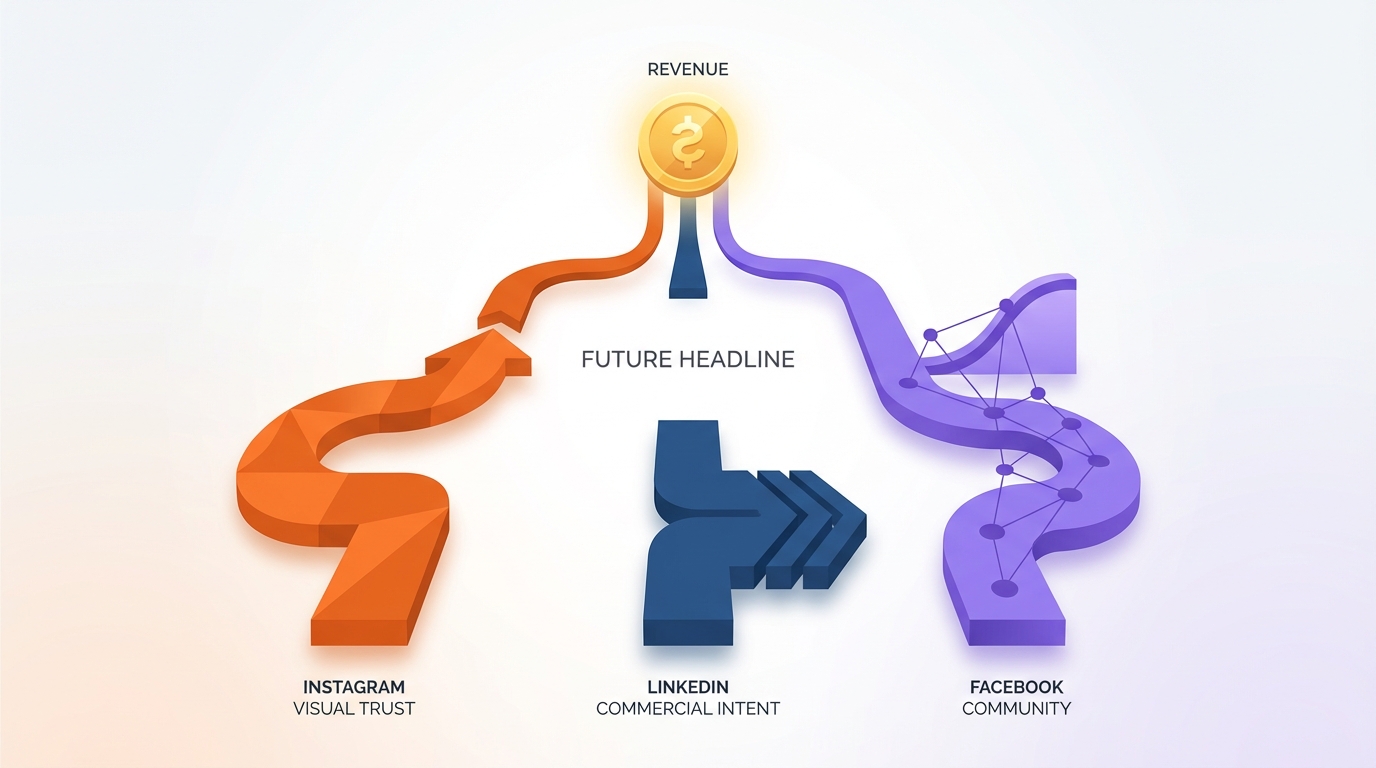
Instagram builds trust through visual proof. LinkedIn
captures commercial intent in professional contexts. Facebook nurtures
community and retargets warm audiences.
Your business doesn't need all three. It needs the one or
two that align with where your buyers actually research and what proof they
require before purchasing.
Stop spreading budget based on FOMO. Start concentrating
resources where your buyers actually are. The engagement metrics might look
smaller but the revenue impact will be dramatically larger.
Ready to Focus Your Social Strategy?
If you're spreading budget across multiple platforms without
clear ROI, it's time for strategic realignment.
Media Junkie engineers’ platform-specific social strategies
that generate qualified leads not just engagement. We match platform selection
to your buyer behaviour and commercial model.
Book a Free Social Platform Strategy Session
We'll analyse your buyer journey and deliver a clear recommendation on which
platform(s) will actually drive revenue for your business.