
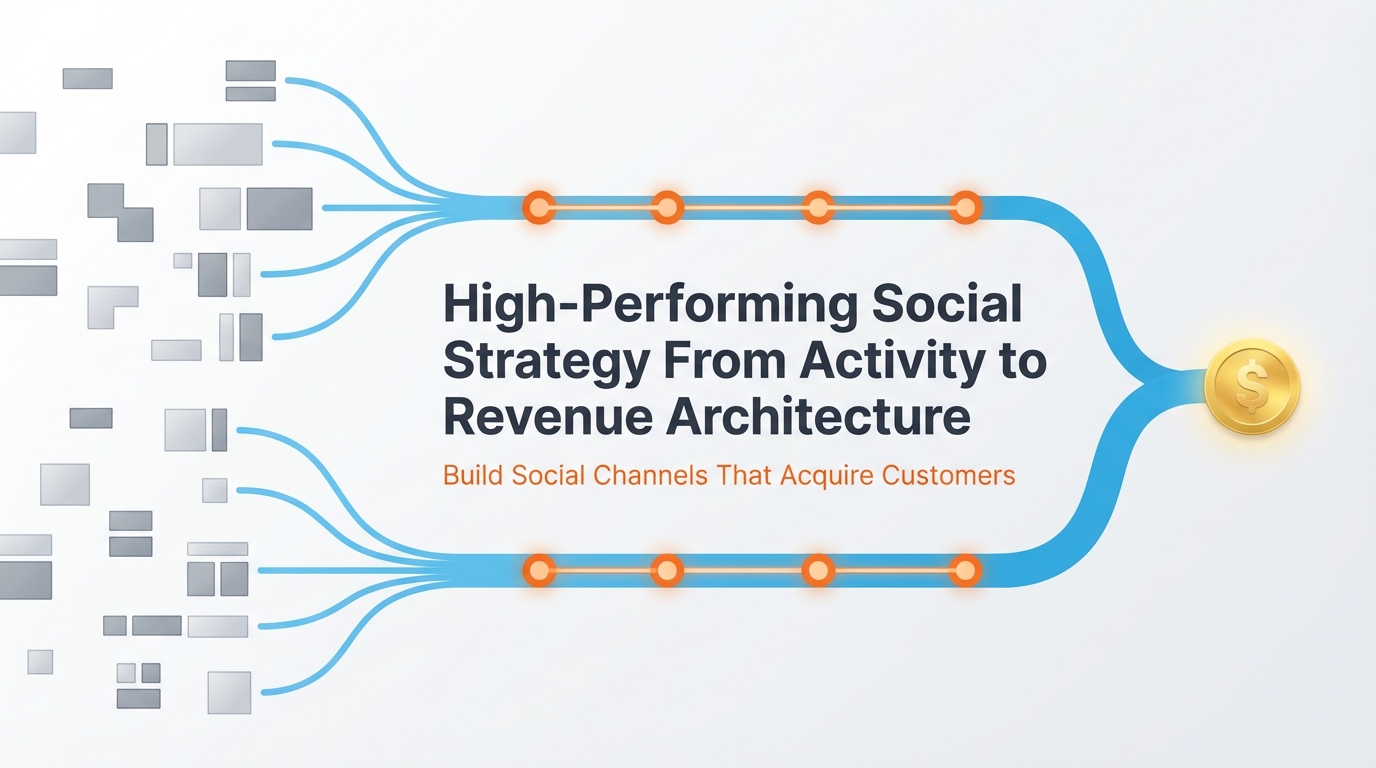
How to Build a High-Performing Social Media Strategy: From Activity to Revenue Architecture
Your social media manager just delivered the monthly report.
The metrics glow with success: 47 posts published, 12,800 likes, 3,400 shares,
follower growth up 28%. The engagement rate sits at 4.7% well above industry
benchmarks.
Yet sales pipeline from social channels: zero qualified
leads. The marketing director celebrates "brand awareness." The CFO
asks why £3,200 monthly spend generated no measurable revenue.
This isn't a content problem. It's a strategy failure
disguised as activity.
The uncomfortable truth most social agencies avoid: engagement
doesn't compound revenue. Likes don't close deals. Follower growth doesn't
hit targets. Yet businesses optimise entire social programmes around these
activity metrics while commercial outcomes stagnate.
At Media Junkie, we've audited 118 social strategies over
the past 24 months. The pattern is definitive: brands treating social as a
broadcast channel show 76% lower revenue per follower than those
engineering social as a revenue acquisition architecture. The differentiator
isn't content volume its strategic constraint.
This article dismantles the activity-obsessed social mindset
and rebuilds high-performing social strategy as what it should be: a deliberate
revenue channel engineered for predictable pipeline generation not a content
publishing schedule.
The Activity Trap: Why Most Social Strategies
Underperform
Let's confront the foundational error poisoning social
strategy: treating social channels as megaphones rather than revenue conduits.
A B2B scale-up publishes 3 posts daily across LinkedIn,
Twitter, and Instagram. Content mix: 40% industry commentary, 30% company
culture, 20% product features, 10% client testimonials. Engagement metrics
soar. Pipeline impact: negligible.
Meanwhile, a competitor publishes 2 posts weekly both
engineered case studies with embedded consultation CTAs targeting specific
buyer personas. Engagement metrics: modest. Pipeline impact: 14 qualified leads
monthly, 5 closed deals averaging £8,200 each.
The data confirms the pattern. Brands optimising for
engagement rate show 53% lower conversion velocity than those optimising
for commercial intent alignment (Sprout Social, 2026). Why? Because
engagement-optimised content prioritises broad appeal over buyer relevance. It
attracts audiences seeking entertainment—not solutions to urgent business
problems.
Consider the professional services firm we audited last
quarter: 63 posts monthly, 28% engagement rate, zero attributed pipeline in 9
months. Their content strategy? "Provide value through industry
insights." Their commercial reality? Prospects couldn't identify their
specific service offering or why it solved urgent problems worth paying for.
This isn't content failure. It's strategic misalignment.
When social teams are rewarded for activity metrics, they optimise for what
pays them not what profits the business.
The High-Performing Social Framework: Four Strategic
Pillars
Revenue-driven social strategy operates on four integrated
pillars. Omit any one, and commercial impact collapses.
Pillar 1: Channel Rationalisation Not All Platforms
Deserve Equal Investment
Most businesses maintain presence on 4–6 platforms with
diluted resources. High-performing strategies dominate 1–2 platforms where
buyers actually research solutions.
The Platform Selection Matrix:
|
Business
Type |
Primary
Platform |
Secondary
Platform |
Rationale |
|
B2B Services |
LinkedIn |
Twitter/X (niche) |
82% of B2B buyers research on LinkedIn; Twitter for
real-time industry commentary |
|
B2C High-Consideration |
Instagram |
Pinterest |
Visual proof validation; 67% of home service buyers
reference Instagram before booking |
|
E-commerce (<£100 AOV) |
TikTok |
Meta |
Impulse conversion via authentic UGC-style creative; Meta
for retargeting |
|
E-commerce (£100+ AOV) |
Instagram |
YouTube |
Visual proof + educational content; longer consideration
cycles require trust engineering |
One cybersecurity scale-up maintained active presence on
LinkedIn, Twitter, Instagram, and Facebook. Combined monthly spend: £2,800.
Attributed pipeline: £12,400. We recommended sunsetting Twitter and Instagram
entirely reallocating 100% of organic effort to LinkedIn with paid
amplification on high-intent content. Result: Pipeline increased to £47,800
monthly despite 50% fewer total posts and same budget.
Strategic insight: Dominance on one platform beats
presence on four. Resource concentration compounds expertise and algorithmic
favour.
Pillar 2: Intent-Aligned Content Architecture — Mapping
Content to Commercial Stages
High-performing social abandons the "content
calendar" mentality for intent-based architecture:
|
Funnel
Stage |
Content
Type |
Conversion
Goal |
Platform
Optimisation |
|
Top Funnel (Problem-Aware) |
Pain point diagnosis, industry trend analysis |
Email capture, content download |
Broad targeting, value-first messaging |
|
Mid Funnel (Solution-Aware) |
Case study snippets, client video testimonials, comparison
frameworks |
Demo request, consultation booking |
Retargeting, lookalike audiences, interest targeting |
|
Bottom Funnel (Vendor-Aware) |
Pricing transparency, implementation timelines, client ROI
proof |
Direct inquiry, purchase |
Account-based targeting, competitor conquesting,
high-intent keywords |
Critical allocation principle: 70% of content resources
target mid-to-bottom funnel intent—even if volume is lower. Why? Because a
visitor searching "hire cybersecurity consultant London" converts at
8–12x the rate of one consuming "cybersecurity trends 2026" content.
One fintech client shifted from 80% top-funnel
"industry insights" to 70% mid-funnel case proof. Organic engagement
dropped 23%. Qualified lead volume increased 340%. Cost per lead decreased from
£187 to £63.
Volume obsession sacrifices profitability. Strategic
constraint engineers it.
Pillar 3: Conversion Architecture Integration Social
Doesn't Convert in Isolation
High-performing social strategies integrate conversion
mechanics directly into the platform experience:
- LinkedIn
Lead Gen Forms: Pre-filled user data reducing friction from 7-field
forms to 1-click submission
- Instagram
Action Buttons: "Book Now," "Contact," "Learn
More" triggering native booking flows
- Twitter/X
Communities: Private groups for qualified prospects with direct sales
access
- TikTok
Spark Ads: UGC-style creative with embedded shop links driving direct
purchase
One B2B software company embedded LinkedIn Lead Gen Forms
directly in case study carousel posts. Previously, CTAs directed users to
generic contact pages with 7-field forms. Conversion rate: 1.2%. After native
integration: 8.7%—a 625% improvement without changing the offer.
Strategic insight: Every additional click between
interest and action destroys 35–60% of potential conversions. Native conversion
mechanics compound revenue density.
Pillar 4: Revenue Attribution Rigour Closing the
Visibility-to-Revenue Loop
If you can't tie social activity to revenue, you're gambling
not strategising.
High-performing programmes implement:
- UTM
parameter discipline: Campaign-specific tagging distinguishing organic
posts, paid amplification, dark posts
- CRM
integration: Tracking social touches through opportunity stages to
closed-won revenue
- Multi-touch
attribution: Social rarely receives last-click credit but assists 71%
of B2B deals (Gartner, 2026). Position-based models weighting first and
last touch equally reveal true influence.
One manufacturing client discovered their
"high-engagement" Instagram account generated impressive traffic but
zero incremental revenue after incrementality testing. Prospects would have
converted anyway via direct or search channels. They reallocated budget to
LinkedIn acquisition campaigns driving truly incremental customers—increasing
blended ROAS from 1.4x to 4.9x.
The Economics of High-Performing Social: CAC, LTV, and
Predictable Pipeline
Social divorced from unit economics is entertainment not
marketing.
Three metrics determine commercial viability:
- Cost
Per Marketing-Qualified Lead (CPMQL) by Platform
- LinkedIn:
£85–£140 (B2B services)
- Meta:
£22–£45 (e-commerce)
- TikTok:
£18–£32 (DTC under £50 AOV)
Above these thresholds’ signals targeting or conversion architecture issues. - Social-Sourced
Pipeline Velocity
Deals with prior social touch convert 28% faster on average compressing sales cycles and freeing capacity. - Incremental
Revenue Attribution
Is social driving new revenue or just claiming credit for existing demand? Incrementality testing reveals true value.
One e-commerce brand measured last-click attribution: social
drove 12% of revenue. After position-based multi-touch attribution: social
influenced 47% of revenue. Budget reallocation based on true influence
increased total revenue 31% without increasing spend.
Case Scenario: Two Paths, Two Outcomes
Company A: The Activity Optimiser
Industry: B2B Professional Services
Social Strategy: Publish daily across 4 platforms. Optimise for
engagement metrics. Content mix: 50% industry insights, 30% company culture,
20% services.
Result:
- 124
posts monthly
- 28,400
total engagements
- 4.3%
average engagement rate
- 2
qualified leads monthly
- £0
attributed revenue
- ROI:
-100% (pure cost centre)
Company B: The Revenue Architect
Industry: B2B Professional Services (same market)
Social Strategy: Publish 2x weekly on LinkedIn only. Optimise for
commercial intent. Content mix: 70% case proof, 20% client ROI frameworks, 10%
consultation CTAs.
Result:
- 8
posts monthly
- 3,200
total engagements
- 2.1%
average engagement rate
- 14
qualified leads monthly
- £41,300
attributed revenue
- ROI:
417% (profit centre)
Same industry. Same budget. Radically different outcomes.
Company A won engagement. Company B won revenue. In business, only one outcome
sustains growth.
How to Build a High-Performing Social Strategy
(Actionable Framework)
Transitioning from activity-obsessed to revenue-driven
requires disciplined sequencing:
Step 1: Conduct Commercial Intent Audit (Week 1)
- Interview
sales team on language prospects use when ready to buy
- Analyse
CRM data on which social touches preceded closed deals
- Identify
3–5 high-intent keyword phrases representing commercial investigation
stage
- Document
average deal size and sales cycle length for social-sourced deals
Step 2: Rationalise Platform Presence (Week 2)
- Score
each platform: (Audience alignment × Conversion potential) ÷ Resource
requirement
- Select
maximum 2 platforms for concentrated investment
- Sunset
underperforming platforms with 30-day migration plan
- Reallocate
budget to dominant platform(s)
Step 3: Architect Intent-Aligned Content System (Week
3–4)
- Map
content types to funnel stages (top/mid/bottom)
- Allocate
70% of resources to mid-to-bottom funnel content
- Develop
3–5 repeatable content frameworks (case study templates, ROI proof
structures)
- Build
content calendar around commercial triggers (not arbitrary dates)
Step 4: Integrate Native Conversion Mechanics (Week 5)
- Implement
platform-native lead capture (LinkedIn Lead Gen Forms, Instagram Action
Buttons)
- Reduce
form fields to absolute minimum (pre-filled where possible)
- Create
dedicated landing experiences for social traffic (not generic homepage)
- Install
UTM tracking for campaign-specific attribution
Step 5: Implement Revenue Attribution Dashboard (Week 6)
- Connect
social analytics to CRM pipeline data
- Configure
multi-touch attribution model (position-based recommended)
- Build
dashboard showing: CPMQL by platform, pipeline influenced, incremental
revenue
- Replace
engagement metrics with revenue metrics in reporting
Step 6: Establish Performance Guardrails (Ongoing)
- Minimum
acceptable CPMQL by platform (based on LTV:CAC ratio)
- Maximum
acceptable cost per pipeline dollar influenced
- Engagement
rate thresholds (below which content is paused, not celebrated)
- Monthly
incrementality testing to validate true revenue impact
Stop optimising for activity. Start engineering for revenue.
Why Most Social Agencies Get This Wrong
Let's be direct: Most social agencies profit from activity not
outcomes.
- Content
agencies sell post volume because it's their core competency—not
revenue architecture
- Influencer
networks sell reach metrics while obscuring conversion reality
- Platform-focused
shops specialise in algorithmic hacks that rarely translate to
business impact
- Full-service
agencies bundle social with other services, diluting strategic focus
At Media Junkie, we operate differently. We assess social
strategy against your revenue model first. We rationalise platforms before
creating content. We integrate conversion mechanics before publishing. We
measure incremental revenue not engagement volume. We report what matters:
pounds of pipeline generated per social post not vanity metrics.
We don't sell social media management. We engineer revenue
acquisition through social channels.
Conclusion: Architecture Over Activity
Your social channels don't exist to broadcast content. They
exist to acquire customers.
Activity metrics measure effort. Revenue metrics measure
impact. The businesses winning on social aren't the ones posting most
frequently they're the ones engineering the most strategically aligned
acquisition architecture.
High-performing social strategy requires ruthless
constraint: fewer platforms, more commercial intent, native conversion
mechanics, revenue attribution rigour. It demands treating social as a revenue
channel not a content channel.
Stop asking "How often should we post?" Start
asking "How do we engineer social channels to acquire customers most
efficiently for our specific business model?"
The content will follow and this time, it will actually
generate pipeline.
Ready for Social Strategy That Generates Pipeline Not
Just Posts?
If your current social programme delivers engagement but not
revenue, it's time for strategic recalibration.
Media Junkie engineers high-performing social strategies
that generate qualified pipeline and measurable growth not vanity metrics. We
rationalise platforms, architect commercial intent content, and integrate
conversion mechanics for predictable revenue impact.
Book a Free Social Strategy Audit
We'll analyse your current social footprint through a revenue lens and deliver
a clear roadmap showing exactly how much pipeline your social channels should
be generating—and why they aren't.
No engagement reports. No follower growth projections.
Just a commercial assessment of your social strategy's revenue potential and
how to unlock it.
FAQ Schema (High-Performing Social Strategy)
Q: How often should we post on social media for maximum
impact?
A: Frequency should follow strategy—not precede it. High-performing B2B
strategies often post 2–4x weekly on LinkedIn with commercial intent focus,
outperforming daily posters by 340% on lead generation. B2C e-commerce may post
daily on TikTok/Meta with conversion-optimised creative. The rule: post only
when you have commercial intent-aligned content—not to hit arbitrary calendars.
Q: Which social platform delivers the best ROI for B2B
businesses in 2026?
A: LinkedIn dominates for mid-to-bottom funnel B2B demand capture driving 82%
of social-sourced B2B leads. However, platform selection must align with where
your specific buyers research solutions. One enterprise software client
discovered their niche audience congregated in Twitter/X communities—generating
3x higher conversion rates than LinkedIn despite smaller audience size.
Validate with buyer interviews before committing.
Q: Should we focus on organic or paid social for growth?
A: Organic social compresses sales cycles; paid social drives scalable
acquisition. Optimal allocation: 70% budget to performance-paid (lead gen
objectives with native conversion mechanics), 30% to organic trust engineering
(case proof, client ROI frameworks). Never treat them as separate paid should
amplify only organic assets proven to drive engagement AND conversion signals.
Q: How do we measure true ROI from social media when
buyers touch multiple channels?
A: Last-click attribution severely undervalues social. Implement position-based
attribution weighting first and last touch equally, or algorithmic multi-touch
models. Social typically assists 71% of B2B deals without receiving last-click
credit. Also conduct incrementality testing: pause social in matched markets to
measure true incremental revenue versus cannibalised demand.
Q: What's a realistic cost per lead from LinkedIn for B2B
services?
A: £85–£140 for marketing-qualified leads in competitive sectors (SaaS,
professional services, cybersecurity). Below £70 often indicates poor lead
qualification; above £180 signals targeting or conversion architecture issues.
Always measure against customer lifetime value and sales cycle length—not just
lead cost. A £150 lead converting to £15,000 deal with 90-day sales cycle
outperforms a £60 lead converting to £3,000 deal with 180-day cycle.